
SHARE:


The Intelligence Gap in Indian Agriculture
What if I told you that one of the biggest challenges in Indian agriculture isn’t the monsoon, the soil, or the market, but a missing link in intelligence?
Let me take you into a moment that shaped this realization for me.
The Story That Sparked It
A few months ago, I was in a district office in eastern India. A dedicated agricultural officer, let’s call him Ravi, was juggling three phone calls, two registers, and a dozen concerns at once.
A sudden pest outbreak began affecting crops in a cluster of villages. Farmers were panicking. The administration wanted immediate numbers. And Ravi, despite being smart, committed, and experienced, was struggling because he lacked the real-time information he needed.
Rainfall records were stored in one system. Crop data came from another source. Pest surveillance reports were filed manually. Market trends were in PDFs in someone’s email. Farmer details were available only if he could access a slow desktop system.
He looked at me and said something I will never forget:
“Sir, the data exists. But the intelligence doesn’t reach me when I need it.”
That is the moment Agri IQ stopped being an idea and became a mission.
An Invisible Gap That Costs Us Every Day
The more we travelled, the more we listened, the clearer it became.
India’s agricultural ecosystem is rich, full of data, insights, and expertise, but it lives in pieces:
- Soil health in one department
- Irrigation records in another
- Weather insights on a portal
- Market prices somewhere else
- Farmer profiles scattered across databases
Everyone works hard, yet everyone sees only a slice of the whole picture. It’s like trying to solve a puzzle without knowing what the final image should look like.
This is the intelligence gap, an invisible barrier that slows decisions, weakens interventions, and leaves our farmers unsupported at crucial moments.
And the truth? This gap is not because people don’t care. It’s because the system was never built to be connected.
The Turning Point: When We Asked, “What If?”
At Dexian, we began asking ourselves:
What if every officer could see real-time crop health on their phone?
What if advisories reached farmers in their own language, instantly?
What if predictions, not just reports, guided decisions?
What if policy and field action were always in sync?
And most importantly:
What if intelligence could flow freely across the entire ecosystem?
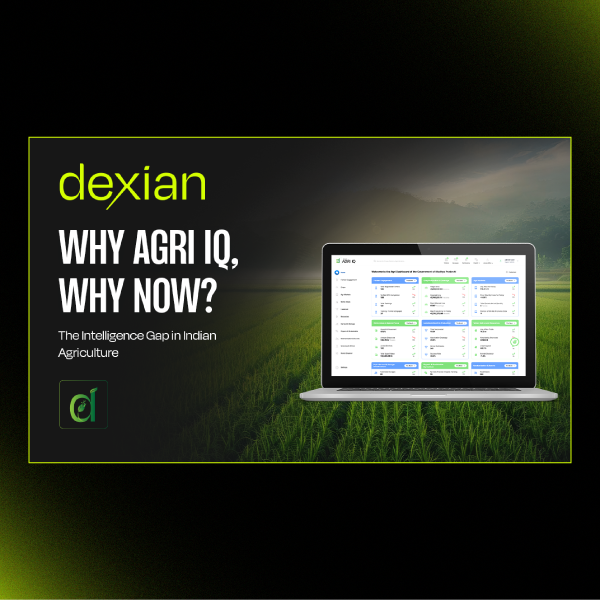
That “what if” became Agri IQ, a Decision Intelligence System designed to unify, predict, and transform agricultural governance.
Agri IQ: Where Data Becomes a Living Story
Imagine Ravi again. But this time, he opens a single app on his mobile phone.
He sees the exact villages where pest risk is rising, predicted days in advance by AI models.
He sees rainfall, crop status, soil moisture, and farmer profiles unified in one place.
He doesn’t wait for reports; he receives live alerts.
He doesn’t guess; he acts.
He doesn’t react after the crisis; he prevents it.
And at the Secretariat, policymakers see trends unfold in real time, market shifts, scheme coverage, cold-chain utilization, irrigation assets, and early warnings across districts.
The intelligence flows both ways.
From the field to the state.
From the state to the field.
From insight to impact.
That is Agri IQ, not a tool, not a dashboard, but a living intelligence ecosystem.
Why Now? Because India’s Moment Is Now
The timing couldn’t be more critical.
Weather patterns are shifting faster than ever.
Market fluctuations are becoming sharper.
Water stress is growing.
Farmer expectations are evolving.
Governance is becoming more data-driven.
We’re at a point where agriculture needs more than information; it needs predictive, connected, trustworthy intelligence.
And the country is ready for it. With AgriStack, eNAM integration, DPDP compliance, and India’s digital public infrastructure maturing, we are perfectly positioned to build the next generation of agricultural governance.
This is not just an opportunity; this is a responsibility.
Lessons From the Field: What Built Agri IQ
Agri IQ didn’t appear out of thin air. It was shaped by real on-ground experience:
- In Bihar’s BIHAN program, where 45,000+ villages gained unified visibility
- In Agmarknet 2.0, where 4,000+ mandis became smarter and more transparent
- In AIEP, where AI-driven, voice-enabled advisories in 15+ regional languages are empowering smallholder farmers, especially women and low-literacy communities.
These stories taught us one powerful truth:
When intelligence becomes accessible, governance becomes transformative.
And that became the foundation of the Agri IQ.
The Future We are Building
I often say this to my team: “We are not just building technology. We are building trust.”
Agri IQ is built to:
- Help policymakers act faster
- Help field officers work smarter
- Help farmers feel seen, supported, and empowered
- Help states anticipate challenges instead of reacting to them
- Help India build resilience, sustainably and confidently
This is intelligence with purpose.
Intelligence with empathy.
Intelligence is built into the Business for Good.
So, Why Agri IQ?
Because Ravi should never have to scramble for information again.
Because farmers deserve timely, accurate guidance.
Because policymakers deserve clarity, not chaos.
Because India deserves predictive, not reactive governance.
Because the future of agriculture depends on the intelligence we connect today.
And most importantly:
Because the time for smarter, connected agricultural intelligence is not tomorrow.
It is right now.
Because the time for smarter, connected agricultural intelligence is not tomorrow. It is right now.
– Venkat Lakshminarasimha , Executive Director, DISC – Solutions, India & Middle East, Dexian
SHARE:
