
SHARE:


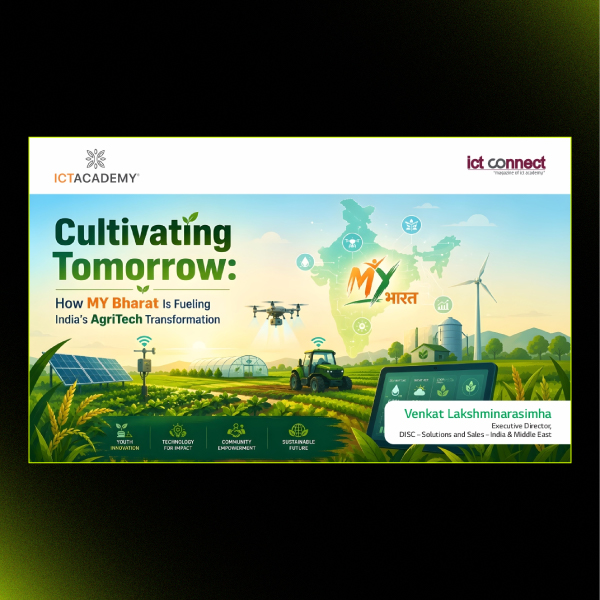
As India advances toward its long-term vision of a modern, inclusive, and resilient agricultural economy, digital technology has emerged as a central pillar of transformation. Under the MY Bharat initiative, the Government has integrated youth empowerment, digital public infrastructure, and on-ground agricultural reforms to reshape how farming is practiced, especially for small and marginal farmers across the country.
The Vision: Agricultural Modernization Through Technology
Agriculture remains foundational to the nation’s socio-economic landscape, with nearly half of the workforce dependent on farming. To address longstanding challenges like fragmented landholdings, climate variability, low mechanization, and market volatility, the Government’s approach emphasizes technology adoption, data-driven decision-making, and scalable digital systems, all aligned with India’s long-term development roadmap towards 2047.
This article was originally written by Venkat Lakshminarasimha, Head of Solutions at Dexian India, and first published by ICT Connect; shared here for informational purposes only, with full credit to the source.
Key trends in technology include precision farming, artificial intelligence, Internet of Things (IoT), geospatial analytics, and digital marketplaces, which collectively aim to enhance productivity, reduce input costs, and build climate resilience.
Digital Agriculture Mission: A National Framework
At the heart of the transformation is the Digital Agriculture Mission, a government-led program designed to create foundational digital public infrastructure for agriculture. The mission focuses on three core components that reimagine the way farming systems operate:
- Farmer Registry — issuing unique digital IDs linked to structured land records, crop history, and socio-demographic profiles.
- Crop Registry & Digital Crop Survey — comprehensive recording of crops sown across regions through mobile surveys and geo-referenced maps.
- Krishi Decision Support System (DSS) — a geospatial platform that integrates remote sensing, weather, soil, and crop data to provide actionable insights for farmers.
The mission’s stated goal is to generate crore-level Farmer IDs, aiming for an inclusive database covering farmers across all states and union territories, with large-scale digital crop surveys expected to begin shortly.
This systemic digitalization enables targeted service delivery, efficient resource use, and more accurate planning at scale, turning traditional farming into a data-informed discipline where decisions about sowing, irrigation, fertilization, and risk management are supported by real-time analytics.
Grassroots Implementation: Digital Crop Surveys & Field Registries
On the ground, the rollout of Digital Crop Surveys and Farmer Registries exemplifies how digital public infrastructure is being operationalized. These efforts are being carried out through on-field surveys that capture crop-wise data at the village and tehsil levels, helping build an accurate picture of cultivated areas, cropping patterns, and seasonal variations.
Such field-level digital engagement serves several critical purposes:
- It feeds the Digital Agriculture Mission’s data backbone, ensuring high-quality information at scale.
- It paves the way for bespoke advisories and support services tailored to individual farmers’ cropping decisions and soil profiles.
- It underpins evidence-based policy design and delivery, allowing for more precise agricultural planning at district, state, and national levels.
Engaging Youth Through MY Bharat Experiential Learning
A distinctive aspect of MY Bharat’s strategy is its emphasis on experiential learning programs connected with flagship initiatives like the Digital Agriculture Mission. These programs provide youth with opportunities to engage directly with agricultural transformation projects, from participating in field surveys to contributing to on-ground digital engagements in rural areas.
By bridging theoretical knowledge with real-world application, these initiatives empower young citizens to contribute meaningfully to national priorities while gaining valuable practical experience. Such engagement helps build a cadre of skilled professionals who understand both the agricultural landscape and the digital tools reshaping it.
Technology Integration: A Broader Ecosystem Perspective
Beyond the Digital Agriculture Mission, the Government’s approach encompasses multiple ecosystem enablers that extend the impact of technology on agriculture:
- Precision agriculture tools — Using sensors, satellite data, and analytics to optimize input usage and improve yields.
- AI-enabled insights — Leveraging algorithms to forecast crop health issues, pest pressures, and market signals.
- IoT Devices — Integrating real-time soil moisture, weather, and nutrient data for fine-tuned farm management.
- Drones & robotics — Providing aerial imagery and mechanized support for large-area monitoring and site-specific interventions.
- Climate-smart farming — Supporting sustainable practices that adapt to environmental shifts and resource constraints.
When combined with digital registries and decision-support systems, these technologies underpin a holistic agri-ecosystem that benefits farmers, rural communities, policy planners, and allied service providers.
Towards a Future-Ready Agriculture
The Government’s MY Bharat-linked initiatives represent a paradigm shift in Indian agriculture, moving from manual, fragmented approaches to a unified, digital, and data-centric framework. Real-time crop data, structured digital identities, and predictive analytics together create an agricultural ecosystem that is more resilient, efficient, and capable of sustaining farmer livelihoods in a rapidly changing world.
By integrating youth participation, cutting-edge technology, and digital infrastructure, this agenda lays the foundation for a future where farming is both smart and sustainable, helping the nation realize its long-term vision of a prosperous, inclusive, and technologically empowered Bharat.
SHARE:
