
SHARE:


Across organizations, hiring continues to scale, yet productivity lags. New hires take months to contribute meaningfully, performance variability remains high, and teams struggle to convert potential into measurable outcomes. The challenge is not acquiring talent, but transforming it into billable, impact-generating capability at speed.
This is where leading organizations are redefining their approach. They are no longer optimizing for hiring volume or training completion; they are building systems that accelerate time-to-value.
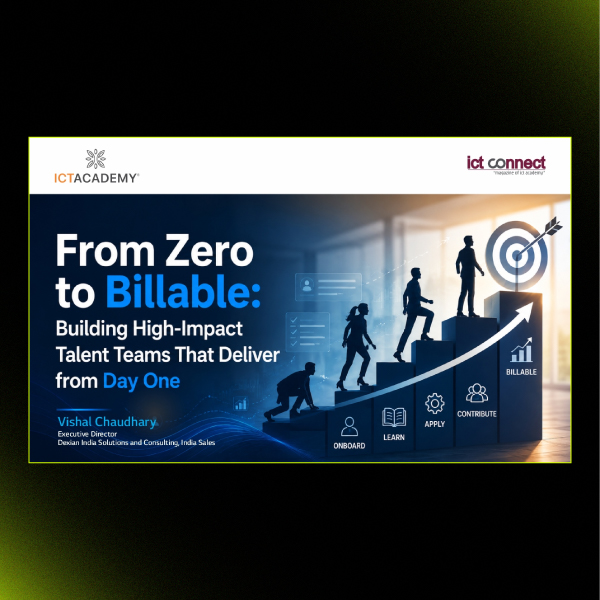
This article was originally written by Vishal S. Chaudhary, Executive Director at Dexian India, and first published by ICT Connect; shared here for informational purposes only, with full credit to the source.
Because in today’s environment, competitive advantage is not just about who you hire, but how quickly that talent starts delivering.
From Hiring to Value Creation
Traditional talent models were designed for stability. Structured onboarding, gradual exposure, and linear development paths defined how employees transitioned into roles. But business realities have changed.
Markets demand faster execution. Clients expect immediate impact. And teams must operate in environments where learning cycles are compressed and outcomes are non-negotiable.
This shift is forcing organizations to move beyond onboarding as a process, toward billable readiness as an outcome.
A billable professional is not simply trained, they are:
- Confident in execution
- Aligned to business objectives
- Capable of independent contribution
- Delivering measurable value
The difference is subtle, but critical. Training prepares. Readiness delivers.
Why Traditional Talent Models Fall Short
Despite investments in learning and development, many organizations struggle to achieve consistent productivity from new hires. The reasons are structural.
Training Without Context
Generic onboarding programs often prioritize information over application. Employees understand tools and processes in isolation, but struggle to apply them in real-world scenarios.
The result: knowledge without execution.
Delayed Exposure to Real Work
In many environments, new hires spend weeks or even months before engaging with actual projects. While this reduces short-term risk, it significantly delays learning and confidence-building.
The result: extended ramp times and slow productivity curves.
Manager Capacity Constraints
Managers are expected to coach, review, and guide new talent but are often stretched across delivery responsibilities. As a result, coaching becomes inconsistent or reactive.
The result: uneven development and performance gaps.
Reframing the Objective: Speed to Billability
High-performing organizations approach talent differently. They design for one core metric:
How quickly can a new hire become independently productive and billable?
This requires a shift from activity-based onboarding to outcome-driven enablement.
The Zero-to-Billable Model
1. Hire for Learning Agility, Not Just Experience
Experience accelerates familiarity, but agility drives adaptability.
Leading teams prioritize:
- Problem-solving ability
- Curiosity and learning mindset
- Communication and collaboration
Because in dynamic environments, the ability to learn fast often outweighs what is already known.
2. Integrate Learning with Real Work
The fastest way to build capability is through application.
Instead of separating training and execution, high-impact teams:
- Introduce live project exposure early
- Enable shadowing of experienced performers
- Use real scenarios as learning environments
Learning is no longer a phase—it becomes embedded in delivery.
3. Build Structured, Outcome-Oriented Learning Journeys
Effective talent programs are not ad hoc. They are designed with clear progression paths:
- Foundation: Tools, systems, and domain understanding
- Application: Guided execution on real tasks
- Independence: Ownership of deliverables
Each stage is tied to measurable outcomes, not just completion milestones.
4. Embed Continuous, Contextual Coaching
Coaching is the single biggest multiplier of talent performance.
But its effectiveness depends on timing and relevance.
High-performing organizations:
- Conduct regular, deal or task-specific reviews
- Provide immediate, actionable feedback
- Enable peer learning and knowledge sharing
Coaching is not an event—it is integrated into everyday work.
5. Measure What Matters: Readiness, Not Activity
Traditional metrics- training hours, module completion, attendance offer limited insight into actual performance.
Instead, leading teams track:
- Time to first meaningful output
- Time to independent execution
- Quality and consistency of deliverables
- Contribution to business outcomes
This creates visibility into real progress and enables early intervention.
6. Define Clear Milestones to Billability
Clarity accelerates execution.
Structured checkpoints ensure alignment across teams and individuals:
- Early-stage: Tool and process familiarity
- Mid-stage: Assisted contribution
- Advanced-stage: Independent delivery
- Final-stage: Full billable readiness
This framework reduces ambiguity and creates accountability.
The Role of Technology in Talent Enablement
Technology plays a critical role but, as with all systems, its impact depends on how it is used.
Learning platforms, collaboration tools, and automation frameworks can accelerate onboarding and provide access to knowledge at scale. They enable faster feedback loops, real-time tracking, and structured learning experiences.
However, technology alone does not create capability.
It must be supported by:
- Strong process design
- Manager-led engagement
- A culture of continuous learning
When aligned correctly, technology becomes an enabler of speed and scale and not a substitute for capability building.
Building a Culture of Early Impact
Beyond frameworks and processes, high-impact talent systems are underpinned by culture.
Ownership from Day One
Employees are expected to contribute, not just learn. Accountability is built early.
Feedback as a Growth Engine
Frequent, constructive feedback accelerates development far more than periodic reviews.
Alignment to Business Outcomes
Every role is connected to value creation—ensuring employees understand the impact of their work.
The Strategic Advantage
The ability to build billable talent quickly is no longer an operational metric—it is a strategic capability.
Organizations that excel in this area:
- Scale faster without compromising quality
- Improve utilization and profitability
- Reduce attrition through engagement and confidence
- Deliver consistent outcomes to clients
In contrast, those that rely on traditional models face prolonged ramp times, inconsistent performance, and lost opportunities.
Where Talent Starts Delivering Real Value
The journey from zero to billable is not a function of time; it is a function of design.
Organizations that succeed do not leave talent development to chance. They build structured, outcome-driven systems that integrate learning, execution, and coaching into a unified model.
Because ultimately, talent does not create value when it is hired.
It creates value when it performs.
SHARE:
